

Developing Secure Digital Key Apps for Automotive: The 2026 Process
Developing a secure digital key app for the automotive industry requires a rigorous, multi-layered process that integrates hardware, software, and cloud security. This guide outlines the essential steps for building a robust system, from defining communication protocols to establishing secure backend infrastructure. It covers the technical architecture, security standards, and user experience considerations necessary to create a reliable and safe digital key solution for modern vehicles. For additional details, review the MEDL Mobile AI App.
BLE and UWB Protocols
The foundation of any digital key system is its communication protocol. Bluetooth Low Energy (BLE) is the primary technology used for initial pairing and basic access. BLE is a low-power wireless technology that allows devices to exchange data over short distances. It is essential for the initial handshake between the smartphone and the vehicle. However, BLE alone is not sufficient for precise location-based unlocking due to its limited ranging accuracy. To address this, Ultra-Wideband (UWB) is often integrated. UWB is a radio technology that provides high-precision ranging and secure communication. It allows the vehicle to determine the exact distance to the key fob or smartphone, ensuring that the car only unlocks when the user is physically close. This combination of BLE and UWB creates a robust and secure access mechanism. For additional details, review the Careers and Opportunities MEDL.
Pairing and Authentication
The pairing process is the first critical step in establishing a secure connection. During pairing, the smartphone and the vehicle exchange cryptographic keys. This process must be protected against man-in-the-middle attacks. Secure pairing protocols, such as those defined by the Car Connectivity Project (CCP), ensure that only authorized devices can communicate with the vehicle. The authentication process involves verifying the identity of both the device and the vehicle. This is typically done using digital certificates and public key infrastructure (PKI). By using strong cryptographic algorithms, the system ensures that the communication channel is encrypted and tamper-proof. For additional details, review the Resources MEDL Mobile.
Proximity Detection
Secure Backend Infrastructure
The backend infrastructure is the brain of the digital key system. It manages user accounts, vehicle data, and key permissions. A secure backend must be designed to handle high availability and low latency. It is responsible for issuing and revoking digital keys, managing user profiles, and logging access events. The backend must be protected against various cyber threats, including denial-of-service attacks and data breaches. To achieve this, the system should use end-to-end encryption and secure APIs. The backend also plays a crucial role in over-the-air (OTA) updates, allowing the vehicle's software to be updated securely. This ensures that the digital key system remains up-to-date with the latest security patches and features. For additional details, review the Beyond the Surface Deep.
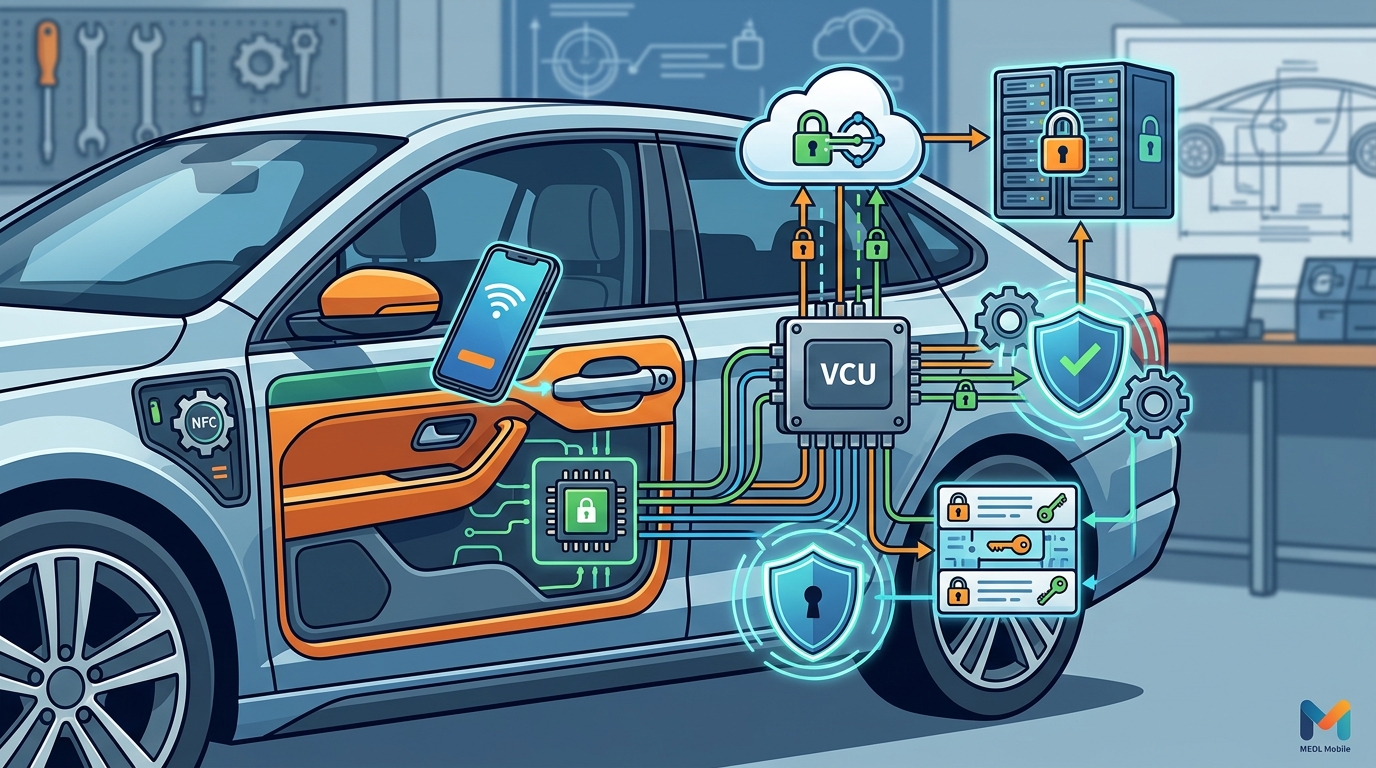
Key Management and Revocation
Data Privacy and Compliance
Data privacy is a major concern for digital key systems. The backend collects and stores sensitive user data, including location information and access logs. This data must be protected in accordance with privacy regulations such as GDPR and CCPA. The system should implement data minimization principles, collecting only the data necessary for its operation. User consent must be obtained before collecting any personal data. Additionally, the backend should provide users with tools to view, export, and delete their data. By prioritizing data privacy, the system builds trust with users and complies with legal requirements.
Key Takeaways
- BLE is used for initial pairing and basic access, while UWB provides precise ranging for secure unlocking.
- Secure pairing protocols and PKI are essential to prevent man-in-the-middle attacks during the initial handshake.
- The backend infrastructure manages user accounts, key permissions, and access logs.
- Key management and revocation are critical for controlling access and responding to security threats.
- Data privacy and compliance with regulations like GDPR are paramount for building user trust.
- Over-the-air updates ensure the digital key system remains secure and up-to-date.
- A dual-protocol approach combining BLE and UWB enhances both security and user experience.
Frequently Asked Questions
What is the difference between BLE and UWB in digital keys?
How does a digital key prevent relay attacks?
Digital keys use UWB for precise ranging, which makes it difficult for attackers to extend the signal range. Additionally, secure pairing protocols and encryption protect the communication channel from tampering.
What role does the backend play in a digital key system?
The backend manages user accounts, issues and revokes digital keys, and logs access events. It also handles over-the-air updates and ensures data privacy and compliance.
Can digital keys be shared with other users?
Yes, digital keys can be shared with other users. The backend can issue new keys with specific permissions, such as time-limited access or restricted functions.
How are digital keys updated over the air?
Digital keys are updated over the air through secure OTA updates. The backend sends new software or security patches to the vehicle, ensuring the system remains up-to-date and secure.
What are the main security threats to digital keys?
Conclusion
Developing a secure digital key app for the automotive industry is a complex but rewarding process. It requires a deep understanding of communication protocols, backend infrastructure, and security best practices. By combining BLE and UWB for precise and secure access, and building a robust backend for key management and data privacy, you can create a digital key system that meets the highest standards of security and user experience. MEDL Mobile offers expertise in mobile app development and AI, helping you bring your digital key vision to life. to learn more about how we can support your project.