

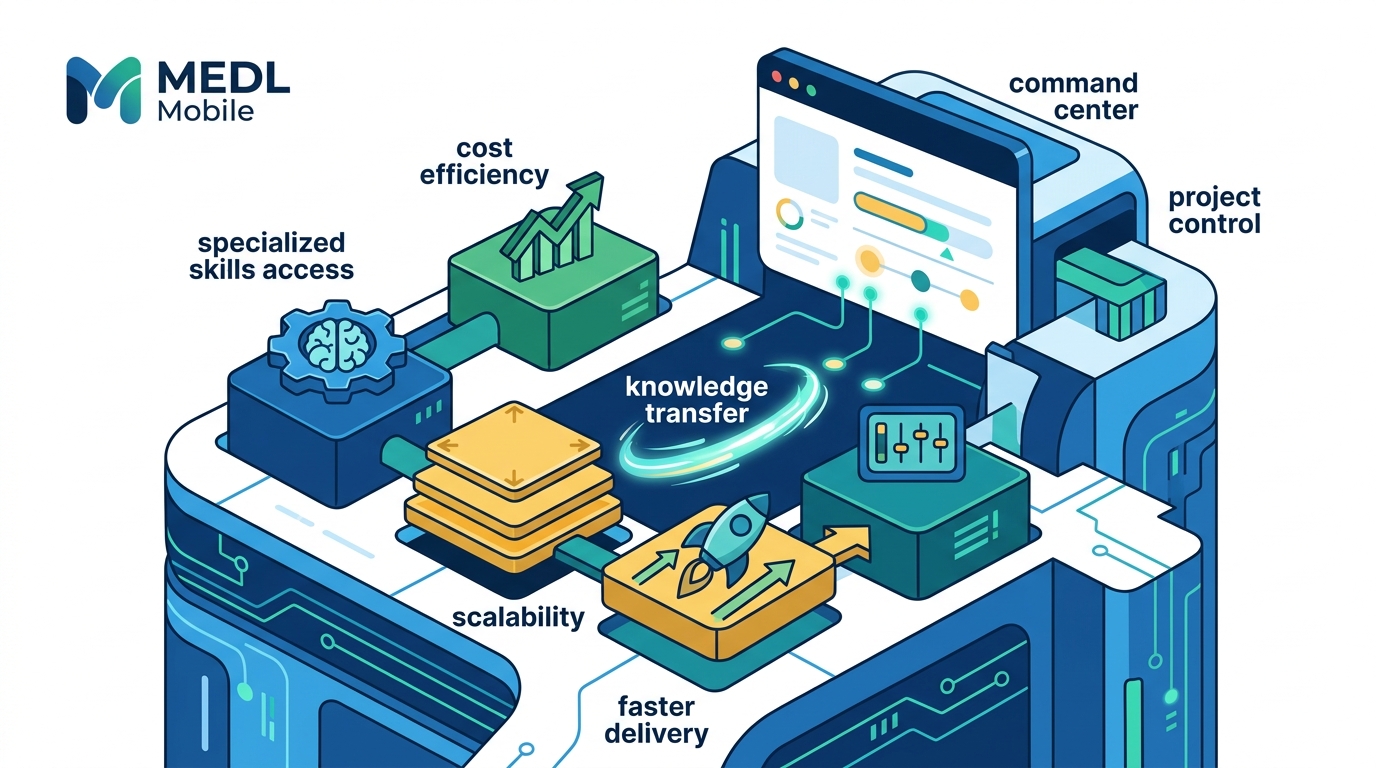
Team augmentation is the practice of adding specialized external talent to an existing internal team to fill specific skill gaps or accelerate delivery. This approach allows organizations to maintain full project control while accessing high-level expertise without the overhead of permanent hiring. This guide covers six core benefits: specialized skills access, cost efficiency, scalability, faster delivery, project control, and knowledge transfer. We also examine how agencies like MEDL Mobile integrate these models to support complex digital product development in Southern California and beyond.
Specialized Skills Access
Accessing niche technical expertise is often the primary driver for adopting an augmentation model. In the modern tech landscape, generalist developers are rarely sufficient for complex product builds. Organizations frequently require specific proficiency in areas such as artificial intelligence integration, augmented reality, or advanced mobile architecture. These skill sets are rare and command high salaries in the permanent labor market. For additional details, review the MEDL Mobile AI App.
By augmenting a team, a company can bring in a senior engineer who specializes in a specific framework or protocol for the duration of a critical project phase. This ensures that the product benefits from deep, domain-specific knowledge without the organization needing to maintain a full-time roster of such specialists. For example, a healthcare startup might need an expert in HIPAA-compliant mobile security for a six-month sprint. Hiring a full-time expert for a temporary need is inefficient. Augmentation provides the exact skill set required, precisely when it is needed. For additional details, review the Careers and Opportunities MEDL.
The Value of Senior Talent
Senior engineers and architects bring more than just code. They bring architectural foresight and risk mitigation strategies. When a team is augmented with senior talent, the internal team benefits from real-time code reviews and architectural guidance. This elevates the entire codebase quality. The external expert acts as a mentor and a problem solver, ensuring that technical debt is minimized from the start.
Emerging Technology Expertise
Technology evolves rapidly. Keeping an internal team up to date on every emerging trend is impossible. Augmentation allows teams to tap into experts who live and breathe new technologies. Whether it is the latest in LLM-driven search optimization or new VR interaction paradigms, augmented talent brings current best practices directly into the workflow. This keeps the product competitive and future-proof.
Cost Efficiency
Reduced Recruitment Costs
Recruiting for specialized roles is expensive and time-consuming. Agency fees, job board postings, and the internal time spent interviewing candidates add up quickly. When working with an established agency, the recruitment burden is shifted. The agency handles the sourcing, vetting, and onboarding of talent. This saves the client organization significant time and money in the hiring process.
Predictable Budgeting
With a retainer-based augmentation model, costs become predictable. Organizations can forecast their monthly tech spend with greater accuracy. This is crucial for startups and enterprises alike, as it allows for better cash flow management. There are no surprise overtime costs or unexpected benefits adjustments. The financial model is transparent and aligned with project milestones.
Scalability
Scalability is the ability to adjust team size up or down in response to project demands. Tech projects are rarely linear. They often have peaks and valleys in workload. A fixed internal team struggles with this variability. During peak development phases, the team may be understaffed, leading to burnout and missed deadlines. During maintenance phases, the team may be overstaffed, leading to idle time and wasted budget.
Team augmentation provides elastic scalability. When a major feature launch is approaching, the team can be expanded with additional developers or QA testers. Once the launch is complete and the workload stabilizes, the augmented team can be reduced. This elasticity ensures that the team size always matches the project requirements. It optimizes resource utilization and maintains high productivity levels throughout the project lifecycle.
Handling Project Peaks
Project peaks are common in software development. They occur during critical path activities, such as database migration, API integration, or pre-launch testing. These phases require intense focus and often more hands than a standard team provides. Augmentation allows organizations to surge capacity exactly when it is needed. This prevents bottlenecks and keeps the project on schedule.
Long-Term Growth
As a company grows, its technical needs change. What starts as a small mobile app project may evolve into a complex SaaS platform. Augmentation supports this growth by providing the right mix of skills at each stage. It allows the internal team to focus on core strategy while external partners handle the heavy lifting of scaling the infrastructure. This supports sustainable long-term growth without the risk of over-hiring.
Faster Delivery
Time to market is a critical competitive advantage. In the tech industry, being first can determine success or failure. Team augmentation accelerates delivery by adding immediate capacity to the team. There is no onboarding lag associated with new hires. Augmented talent is often pre-vetted and experienced in similar projects. They can hit the ground running, contributing to code and design from day one.
This immediate contribution shortens development cycles. Tasks that would take a small internal team weeks can be completed in days when additional hands are added. Parallel work streams become possible. While one developer works on the front-end, another can work on the back-end, and a third can handle QA. This parallelization significantly reduces the overall project timeline. Faster delivery allows organizations to test their ideas in the market sooner and iterate based on real user feedback.
Parallel Work Streams
Parallel work is the key to speed. When a team is augmented, tasks can be distributed across more individuals. This reduces the dependency chain. Instead of one developer waiting for another to finish a module, multiple developers can work on different modules simultaneously. This reduces idle time and keeps the project moving forward at a consistent pace.
Experienced Onboarding
Experienced augmented talent requires minimal onboarding. They are familiar with standard development workflows, version control systems, and communication tools. This means they can integrate into the team quickly. They do not need extensive training on basic processes. This saves time and allows them to contribute to high-value tasks immediately.
Project Control
Project control is a primary concern for organizations considering outsourcing. Many fear that handing off a project to an external agency will result in a loss of oversight. Team augmentation addresses this fear directly. In an augmentation model, the external talent works as part of the internal team. They follow the internal team's processes, tools, and management structure. The client retains full control over the project direction, priorities, and decision-making.
This is different from a full outsourcing model, where the agency manages the project end-to-end. In augmentation, the client's product manager or tech lead manages the augmented engineers. This ensures that the work aligns perfectly with the company's vision and standards. The client has visibility into every line of code and every design decision. This level of control is crucial for maintaining brand integrity and product quality.
Integration with Internal Processes
Augmented talent integrates seamlessly into existing workflows. They use the same project management tools, such as Jira or Asana. They participate in the same daily stand-ups and sprint planning meetings. They follow the same code review processes. This integration ensures that the augmented team operates as a cohesive unit with the internal team. There is no friction or miscommunication that often arises in fully outsourced projects.
IP Ownership and Security
Intellectual property (IP) ownership is another aspect of project control. In an augmentation model, the client typically retains full ownership of the IP. The augmented talent works under a contract that clearly defines IP rights. This ensures that the client owns the code, designs, and data created during the project. This is a significant advantage over some outsourcing models where IP rights can be ambiguous.
Knowledge Transfer
Knowledge transfer is a long-term benefit of team augmentation that is often overlooked. When external experts work alongside internal teams, they share their expertise, best practices, and problem-solving techniques. This creates a learning environment that elevates the skills of the internal team. The internal developers learn new techniques, tools, and methodologies from their augmented counterparts.
This transfer of knowledge builds internal capability. Over time, the internal team becomes more proficient in the areas where they were augmented. This reduces the need for future augmentation in those areas. It creates a more resilient and versatile internal team. The knowledge gained is retained within the organization, providing a lasting benefit that extends beyond the duration of the project.
Mentorship and Coaching
Senior augmented talent often acts as mentors to junior internal developers. They provide guidance on code structure, debugging techniques, and architectural decisions. This mentorship accelerates the professional growth of the internal team. It helps junior developers advance in their careers and become more effective contributors. This creates a positive feedback loop where the team becomes stronger with each project.
Documentation and Best Practices
Augmented teams often bring rigorous documentation practices. They ensure that code is well-commented and that processes are documented. This creates a knowledge base that the internal team can use in the future. It reduces the risk of knowledge loss when team members leave. It ensures that the project remains maintainable and scalable over time.
Comparison of Engagement Models
| Feature | Full-Time Hiring | Team Augmentation | Full Outsourcing |
|---|---|---|---|
| Cost Structure | High fixed cost (salary + benefits) | Variable cost (billable hours) | Fixed project cost |
| Scalability | Low (slow to hire/fire) | High (elastic team size) | Medium (dependent on agency) |
| Project Control | Full control | Full control (client manages) | Low control (agency manages) |
| Time to Start | Long (recruitment process) | Short (pre-vetted talent) | Medium (onboarding phase) |
| Knowledge Transfer | Internal only | High (collaborative work) | Low (separate teams) |
Key Takeaways
- Team augmentation provides access to specialized skills without the overhead of permanent hiring.
- It offers significant cost efficiency by paying only for utilized time and expertise.
- Scalability allows teams to adjust size up or down based on project demands.
- Faster delivery is achieved through immediate capacity and parallel work streams.
- Full project control is maintained as augmented talent works within the internal team structure.
- Knowledge transfer builds internal capability and reduces future dependency on external help.
- Augmentation is ideal for projects requiring niche expertise, such as AI or AR/VR development.
- It is a strategic tool for balancing speed, cost, and quality in tech projects.
Frequently Asked Questions
What is the difference between team augmentation and outsourcing?
Team augmentation involves adding external talent to an existing internal team, where the client manages the work. Outsourcing involves handing off the entire project to an external agency, which manages the work end-to-end. Augmentation offers more control and integration, while outsourcing offers more autonomy for the agency.
How long does it take to onboard augmented talent?
Onboarding augmented talent is typically faster than hiring full-time employees. Pre-vetted experts can often start contributing within a few days to a week. This is because they are experienced in standard development workflows and require minimal training on basic processes.
Can augmented talent work remotely?
Yes, augmented talent can work remotely or on-site. Many agencies, including MEDL Mobile, operate with distributed teams. Remote work allows for access to a wider talent pool and can be more cost-effective. However, on-site work may be preferred for projects requiring intense collaboration and real-time communication.
How is intellectual property handled in augmentation?
In most augmentation contracts, the client retains full ownership of the intellectual property created during the project. The contract should clearly define IP rights to avoid ambiguity. This ensures that the client owns the code, designs, and data, which is crucial for long-term business value.
Is team augmentation suitable for small startups?
Yes, team augmentation is highly suitable for small startups. It allows them to access senior talent and specialized skills without the high cost of full-time hiring. This enables startups to build high-quality products quickly and efficiently, which is critical for competing in the market.
How does knowledge transfer work in augmentation?
Knowledge transfer occurs through daily collaboration, code reviews, and mentorship. Senior augmented talent shares their expertise and best practices with the internal team. This elevates the skills of the internal developers and builds long-term internal capability.
What types of projects benefit most from augmentation?
Projects that require niche expertise, such as AI, AR/VR, or complex mobile architecture, benefit most from augmentation. These projects often have specific skill requirements that are not common in the generalist labor market. Augmentation provides the exact expertise needed for these specialized tasks.
How do I choose the right agency for augmentation?
Choose an agency with a proven track record in your specific industry and technology stack. Look for agencies that offer flexible engagement models and have a strong culture of collaboration. MEDL Mobile, for example, specializes in AI and mobile app development, making them a strong fit for projects in these areas.
Conclusion
Team augmentation is a powerful strategy for tech projects that require specialized skills, scalability, and speed. It offers a balanced approach that combines the control of in-house development with the flexibility of external expertise. By leveraging augmentation, organizations can optimize their costs, accelerate delivery, and build long-term internal capability. For companies looking to enhance their digital product development, partnering with an experienced agency is a strategic move. MEDL Mobile, based in Southern California, offers deep expertise in AI, mobile apps, and custom software. Their team can integrate seamlessly with your existing staff to drive your project forward. To explore how team augmentation can benefit your next tech project, contact MEDL Mobile today.