

Expert mobile app developers are specialized engineers and designers who build high-performance, scalable software for iOS, Android, and web platforms. Finding the right partner requires a rigorous evaluation of technical depth, communication skills, and domain expertise. This guide provides a step-by-step framework for vetting agencies and freelancers to ensure your startup builds a product that drives growth. For additional details, review the Contact Us x2d MEDL.
Defining Project Requirements
Before contacting a single developer, you must articulate exactly what you need to build. Ambiguity in the initial brief is the primary cause of project failure and budget overruns. A clear definition of scope allows potential partners to provide accurate estimates and timelines. For additional details, review the Careers and Opportunities x2d.
Technical Scope and Platform Selection
Determine whether you need a native application, a cross-platform solution, or a responsive web app. Native apps offer the best performance for complex features like augmented reality or heavy data processing. Cross-platform frameworks allow for faster development and lower costs but may sacrifice some native capabilities. Your choice depends on your target audience and the specific functionality of your product.
Feature Prioritization and MVP Strategy
Startups often fail by trying to build every feature at once. You must identify the Minimum Viable Product (MVP) features that are essential for your first launch. An MVP is the simplest version of your product that allows you to validate your core value proposition with real users. Prioritizing these features helps you manage your budget and accelerate your time to market.
Non-Functional Requirements
Technical requirements extend beyond visible features. You must define performance benchmarks, security standards, and scalability needs. For example, if your app handles sensitive user data, you need to specify compliance requirements such as HIPAA or GDPR. These non-functional requirements significantly impact the architecture and the type of developer expertise you need.
Structured Interview Process
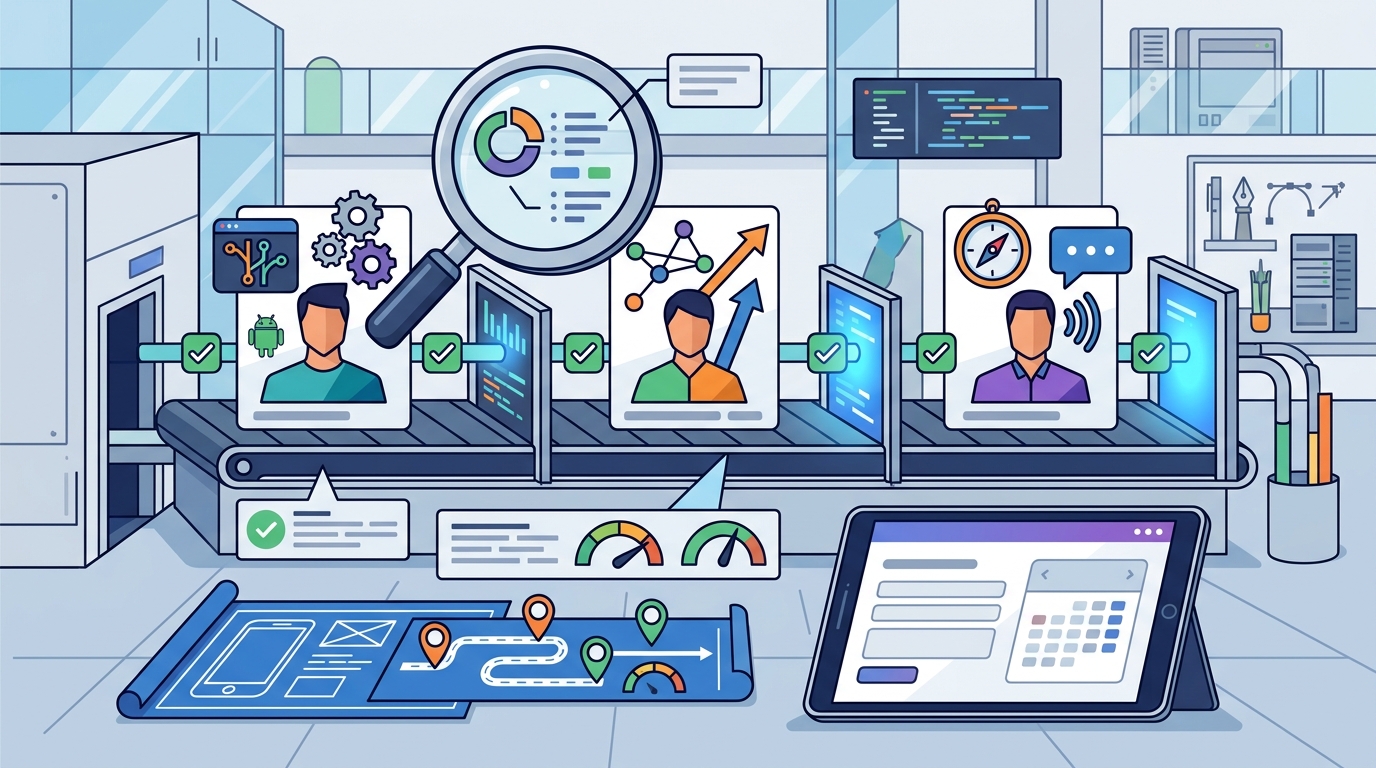
A structured interview process helps you evaluate candidates objectively and reduces the risk of hiring based on gut feeling alone. You should use a consistent set of questions for every candidate to ensure a fair comparison. This process should cover technical skills, problem-solving abilities, and cultural fit.
Technical Assessment and Code Review
Do not rely solely on resumes and self-reported skills. Request a code review or a small technical assignment that mirrors a real challenge in your project. Look for clean, well-documented code that follows best practices. A strong developer should be able to explain their design decisions and trade-offs clearly. This step filters out candidates who may have impressive portfolios but lack the ability to write maintainable code.
Problem-Solving and Communication Skills
Mobile development is a collaborative effort that requires constant communication. Assess how candidates approach ambiguous problems. Do they ask clarifying questions? Do they propose multiple solutions with pros and cons? Effective communication is just as important as technical skill, especially when working with a remote team or an agency. You want a partner who can translate technical constraints into business implications.
Cultural and Process Fit
Evaluate how the candidate or agency works. Do they use agile methodologies? How do they handle feedback and revisions? Ask about their development lifecycle, including how they manage quality assurance and deployment. A mismatch in work style can lead to friction and delays. Ensure their process aligns with your startup's pace and decision-making structure.
Reference Checks
Reference checks are the most critical step in the hiring process. They provide insight into how a developer or agency performs in real-world scenarios. You should contact at least three recent clients, preferably those with projects similar to yours. This step helps you verify claims made during the interview and assess long-term reliability.
Questions to Ask References
Ask specific questions that reveal the candidate's strengths and weaknesses. Inquire about their ability to meet deadlines and stay within budget. Ask how they handled unexpected technical challenges or scope changes. You should also ask about their communication frequency and responsiveness. A good reference will provide balanced feedback, highlighting both successes and areas for improvement.
Evaluating Long-Term Support and Maintenance
Launching an app is only the beginning. You need a partner who can support and evolve your product over time. Ask references about the post-launch experience. Did the developer provide timely bug fixes and updates? Were they responsive to new feature requests? Long-term support is a key differentiator between a one-time vendor and a true strategic partner. Ensure the candidate has a clear plan for ongoing maintenance and support.
Finding Developer Sources
There are several channels for finding mobile app developers, each with its own advantages and risks. You can hire in-house, work with a dedicated agency, or use freelance platforms. The best source depends on your budget, timeline, and the complexity of your project. Each channel requires a different vetting approach.
Specialized Digital Product Agencies
Agencies like MEDL Mobile offer a comprehensive team of engineers, designers, and project managers under one roof. This model is ideal for startups that need a full-stack solution without the overhead of hiring multiple individuals. Agencies bring proven processes and a track record of delivering complex products. They can handle everything from strategy and design to development and launch. Working with an established agency reduces the risk of project failure and provides access to a wider pool of expertise.
Freelance Platforms and Marketplaces
Freelance platforms offer access to a global talent pool at varying price points. This option can be cost-effective for smaller projects or specific tasks. However, it requires more management effort on your part. You are responsible for coordinating multiple freelancers and ensuring quality control. This model works best if you have an experienced technical lead who can oversee the project. Be cautious of extremely low bids, as they often indicate a lack of experience or hidden costs.
In-House Hiring
Hiring in-house developers gives you the most control and direct communication. This is a long-term investment that makes sense once your product has gained traction. It allows you to build a dedicated team that understands your product deeply. However, it comes with higher fixed costs, including salaries, benefits, and office space. In-house hiring is typically not the best first step for early-stage startups with limited budgets. It is better suited for scaling companies that have validated their product-market fit.
Comparison of Developer Sources
| Source Type | Best For | Cost Structure | Management Effort | Risk Level |
|---|---|---|---|---|
| Specialized Agency | Complex, full-stack products | Project-based or retainer | Low | Low |
| Freelance Platform | Specific tasks, small budgets | Hourly or fixed bid | High | Medium |
| In-House Team | Scaling, long-term ownership | Salary + benefits | Medium | Low |
Key Takeaways
- Define your project scope and MVP features before contacting developers to ensure accurate estimates.
- Use a structured interview process that includes technical assessments and code reviews.
- Conduct thorough reference checks with at least three recent clients to verify reliability and communication skills.
- Choose a developer source that aligns with your budget, timeline, and management capacity.
- Specialized agencies offer a lower-risk option for complex projects by providing a full team and proven processes.
- Long-term support and maintenance capabilities are as important as initial development skills.
- Cultural fit and communication style are critical factors in a successful long-term partnership.
Frequently Asked Questions
How much should I budget for a mobile app?
The cost of a mobile app varies widely based on complexity, features, and platform. A simple MVP might cost tens of thousands of dollars, while a complex enterprise app can cost hundreds of thousands. It is essential to get detailed quotes from multiple providers after defining your scope.
What is the difference between native and cross-platform development?
Native development uses platform-specific languages like Swift for iOS and Kotlin for Android, offering the best performance. Cross-platform development uses a single codebase to build for both platforms, which is faster and cheaper but may have performance limitations.
How long does it take to build a mobile app?
Timeline depends on complexity. A simple app might take 2-3 months, while a complex application can take 6-12 months or more. A clear scope and experienced team can help accelerate the timeline.
Should I hire a freelancer or an agency?
Freelancers are cost-effective for small, specific tasks. Agencies are better for complex, full-stack projects that require multiple disciplines like design, development, and project management. Agencies provide more structure and lower risk for startups.
What technical skills should I look for in a mobile developer?
Look for proficiency in relevant frameworks (e.g., React Native, Flutter, Swift, Kotlin), experience with API integration, and knowledge of mobile security best practices. Problem-solving ability and communication skills are equally important.
How do I ensure the developer understands my business goals?
Involve the developer in the early stages of product definition. Share your business model, target audience, and success metrics. A good partner will ask questions to understand the business context, not just the technical requirements.
What is an MVP and why is it important?
An MVP is the minimum version of your product that allows you to test your core hypothesis with real users. It is important because it allows you to validate your idea with minimal investment before building a full-featured product.
How do I protect my intellectual property when working with a developer?
Conclusion
Finding the right mobile app developer is a critical decision that can make or break your startup. By defining your requirements clearly, conducting a structured interview process, performing thorough reference checks, and choosing the right source, you can significantly reduce risk and increase your chances of success. Partnering with an experienced digital product agency like MEDL Mobile provides access to a proven team and comprehensive services that can guide you from idea to launch. Take the time to vet your potential partners carefully, and you will build a foundation for long-term growth and innovation.