

Developing a secure digital key app for the automotive industry requires a rigorous, multi-layered process centered on cryptographic security, hardware integration, and seamless user experience. MEDL Mobile, a digital product agency based in Southern California, has led the architecture and development of the first digital key experience in North America for Toyota, utilizing smartphones for secure vehicle access. This guide covers the essential technical and strategic steps required to build a robust, secure, and user-friendly digital key application.
Secure Element and Hardware Storage
The foundation of any secure digital key app is the secure element. A secure element is a tamper-resistant hardware chip that stores cryptographic keys and performs secure operations. In the context of automotive digital keys, this component is critical because it prevents attackers from extracting the private keys required to unlock the vehicle. The secure element ensures that even if the smartphone is compromised, the keys remain protected within a hardware boundary that is physically difficult to breach.
Hardware Security Modules
Modern smartphones integrate secure elements that comply with industry standards such as FIPS 140-2 or Common Criteria. These modules handle the generation, storage, and use of cryptographic keys. For automotive applications, the secure element must support specific protocols like Bluetooth Low Energy (BLE) and Near Field Communication (NFC) to communicate with the vehicle's onboard unit. The hardware must be capable of performing cryptographic operations without exposing the keys to the operating system or other applications.
Key Storage Best Practices
Storing keys in the secure element requires careful architecture. The private key never leaves the secure element; only the public key is shared with the vehicle. This asymmetric encryption model ensures that the vehicle can verify the phone's identity without the phone ever transmitting its secret credentials. MEDL Mobile's work with Toyota involved coordinating device fingerprinting and key holder validation, ensuring that cryptographic packages are stored securely and managed efficiently across diverse device ecosystems.
Cryptographic Architecture and Key Management
Cryptographic architecture defines how keys are generated, distributed, and rotated. In a digital key system, the relationship between the phone and the vehicle is established through a pairing process that creates a unique cryptographic bond. This bond allows the vehicle to recognize the phone as a trusted key holder. The architecture must support key rotation to mitigate the risk of key compromise over time.
Asymmetric Encryption Models
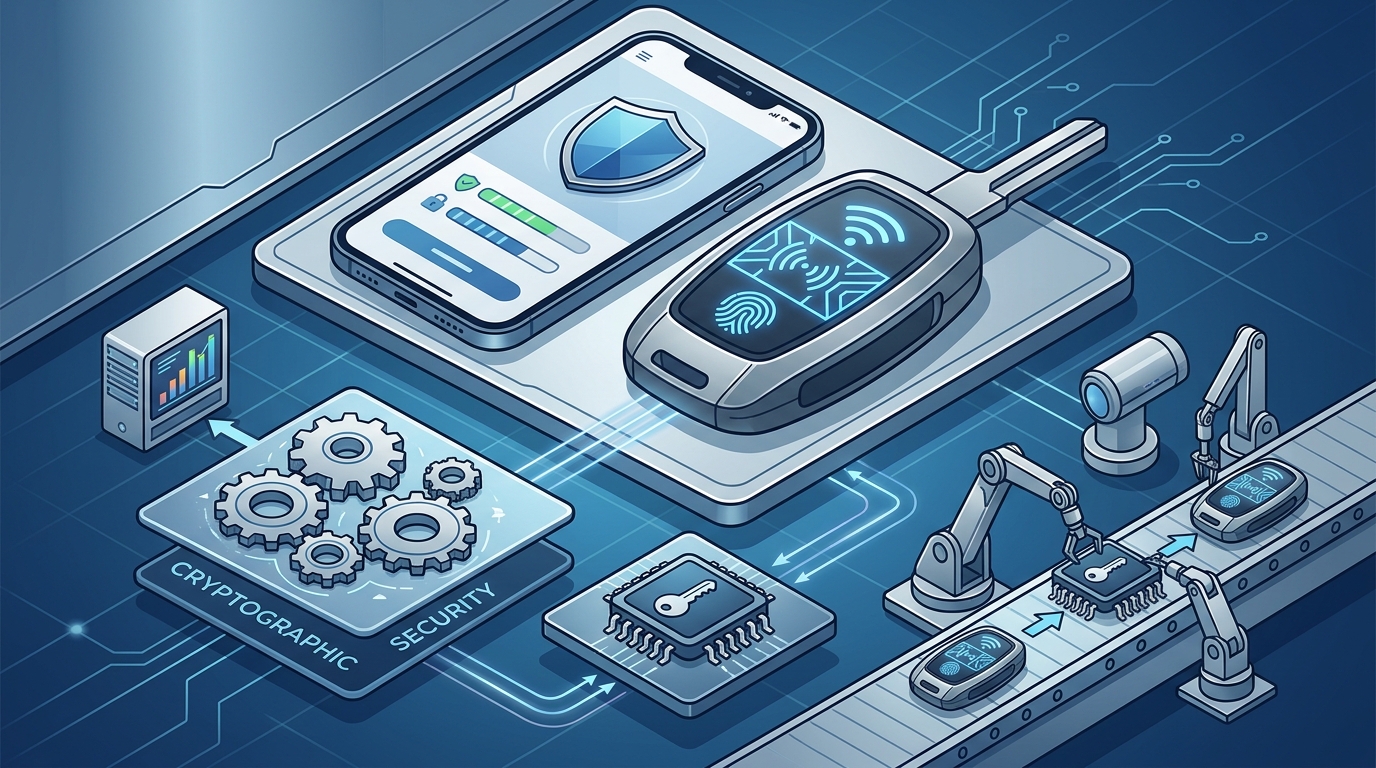
Asymmetric encryption is the backbone of digital key security. The phone holds the private key, while the vehicle holds the corresponding public key. When the phone approaches the vehicle, it generates a challenge response using its private key. The vehicle verifies this response using the public key. This process ensures that only authorized devices can unlock the car. The cryptographic operations must be performed within the secure element to maintain the integrity of the private key.
Key Distribution and Pairing
The pairing process involves the user placing their physical keyfob in the vehicle and activating it, confirming ownership. This step is crucial for establishing the initial trust. Once paired, the system coordinates processes among multiple systems, handling device fingerprinting and key holder validation. The cryptographic packages are then stored securely, facilitating the user's ability to pair the keyfob with their vehicle. This process must be seamless and intuitive for the user, while maintaining the highest level of security.
Biometric Authentication and User Onboarding
Biometric authentication enhances the hands-free user experience by seamlessly integrating with the onboarding process. Facial recognition or fingerprint scanning allows for swift validation of critical interactions with the digital key. This layer of security ensures that even if the phone is lost or stolen, the digital key cannot be used without the authorized user's biometric data. The integration of biometrics must be handled with care to protect user privacy and comply with data protection regulations.
Facial Recognition and PIN Entry
Onboarding Process Design
The onboarding process is the first point of contact between the user and the digital key system. It must be designed to be intuitive and friction-free. Users should be guided through the steps of pairing their phone with the vehicle, enrolling their biometrics, and understanding how to use the digital key. A well-designed onboarding process reduces user frustration and increases adoption rates. MEDL Mobile's experience with Toyota highlighted the importance of creating a system that feels like a journey to parts unknown, yet remains simple and friction-free.
Vehicle Integration and Ecosystem Connectivity
Vehicle integration involves connecting the digital key app with the car's onboard systems. This requires precise technical execution to ensure compatibility with various multimedia platforms and operating systems. The app must communicate with the vehicle's infotainment system, door locks, and ignition system. This integration is complex due to the diverse technological domains and global regions involved.
Infotainment System Connectivity
The infotainment system serves as the central hub for vehicle connectivity. The digital key app must interface with this system to provide status updates, control vehicle functions, and manage key permissions. This requires robust APIs and protocols to ensure reliable communication. The app must handle various scenarios, such as when the vehicle is in motion or when the user is in a different location. The integration must be seamless to provide a cohesive user experience.
Global Region Compatibility
Developing a digital key app for a global market requires ensuring compatibility with different regional standards and regulations. MEDL Mobile led the architecture and development efforts across Toyota's global regions, adhering to their systems and tools. This involved coordinating with various teams to ensure that the app functioned correctly in different markets. The ability to be flexible and agile with complex design systems and development environments is crucial for successful global deployment.
Security Protocols and Threat Mitigation
Security protocols are essential for protecting the digital key system from various threats. These protocols include encryption, authentication, and access control. The system must be designed to withstand attacks such as replay attacks, man-in-the-middle attacks, and side-channel attacks. Regular security audits and penetration testing are necessary to identify and mitigate vulnerabilities.
Replay Attack Prevention
Access Control and Permissions
Access control determines who can use the digital key and what functions they can perform. The system must support different levels of access, such as driver, passenger, and service. Permissions can be granted or revoked by the primary key holder. This feature is useful for sharing the vehicle with family members or service providers. The access control system must be robust and flexible to accommodate various use cases.
User Experience and Frictionless Access
User experience is a critical factor in the success of a digital key app. The app must be intuitive, fast, and reliable. Users should be able to unlock and start their vehicles without any hassle. The design should reflect the brand's identity while providing a seamless digital experience. MEDL Mobile worked within brand guidelines to bring the digital brand to life, introducing design elements that mirrored the retail and marketing iterations of the brand.
Design Iterations and Brand Alignment
Design iterations are essential for refining the user experience. MEDL Mobile went through multiple rounds of design iteration to ensure that the overall direction was pleasing to the client and their agency. The design should be consistent with the brand's visual identity, using signature iconography and rich media content. This alignment ensures that the digital experience feels cohesive and authentic.
Friction-Free Interaction
Friction-free interaction is the goal of any digital key app. Users should not have to fumble with their phones or wait for the system to respond. The app should detect the user's presence and unlock the vehicle automatically. This requires precise sensor integration and efficient communication protocols. The result is a seamless experience that enhances the user's perception of the vehicle's technology.
Testing, Deployment, and Maintenance
Testing is a critical phase in the development of a secure digital key app. Rigorous QA ensures flawless performance, followed by seamless market launch. The app must be tested for security, functionality, and user experience. Deployment involves rolling out the app to users and monitoring its performance. Maintenance includes providing updates and support to address any issues that arise.
Quality Assurance and Security Testing
Quality assurance involves testing the app for bugs, performance issues, and security vulnerabilities. MEDL Mobile employs a team of QA testers who create a customized plan for each application to assure that it has been tested and polished until cleared for market release. Security testing includes penetration testing and code reviews to identify and fix vulnerabilities. This process is essential for ensuring the app's security and reliability.
Post-Launch Support and Updates
Post-launch support is crucial for maintaining the app's performance and addressing user feedback. MEDL Mobile often continues to support an app for 2-3 years after launch as the client organically builds a team to support it. This support includes providing updates, fixing bugs, and adding new features. The maintenance plan should be customized to meet the client's needs and ensure long-term success.
Key Takeaways
- Secure elements are the foundation of digital key security, storing cryptographic keys in tamper-resistant hardware.
- Asymmetric encryption models ensure that private keys never leave the secure element, protecting them from compromise.
- Biometric authentication enhances security and convenience, allowing for hands-free vehicle access.
- Vehicle integration requires precise technical execution to ensure compatibility with diverse multimedia platforms.
- Security protocols must mitigate threats such as replay attacks and man-in-the-middle attacks.
- User experience is critical for adoption, requiring intuitive design and friction-free interaction.
- Rigorous testing and post-launch support are essential for ensuring the app's security and reliability.
- Global deployment requires flexibility and adaptability to accommodate different regional standards and regulations.
Frequently Asked Questions
What is a secure element in a digital key app?
A secure element is a tamper-resistant hardware chip that stores cryptographic keys and performs secure operations. It ensures that private keys remain protected within a hardware boundary, preventing extraction by attackers.
How does asymmetric encryption protect digital keys?
Asymmetric encryption uses a pair of keys: a private key stored on the phone and a public key stored on the vehicle. The phone uses its private key to generate a challenge response, which the vehicle verifies using the public key. This ensures that only authorized devices can unlock the car.
What role does biometric authentication play in digital keys?
Biometric authentication, such as facial recognition or fingerprint scanning, adds an extra layer of security. It ensures that only the authorized user can use the digital key, even if the phone is lost or stolen.
How is a digital key app integrated with a vehicle?
A digital key app integrates with a vehicle through its infotainment system, door locks, and ignition system. This requires robust APIs and protocols to ensure reliable communication and seamless user experience.
What are common security threats to digital key apps?
Why is user experience important for digital key apps?
User experience is critical for adoption. A digital key app must be intuitive, fast, and reliable to provide a seamless experience that enhances the user's perception of the vehicle's technology.
How does MEDL Mobile approach digital key development?
MEDL Mobile leads the architecture and development of digital key apps, ensuring compatibility with diverse multimedia platforms and global regions. They focus on creating a seamless, secure, and user-friendly experience.
Conclusion
Developing a secure digital key app for the automotive industry is a complex process that requires a deep understanding of cryptographic security, hardware integration, and user experience. MEDL Mobile, with its 15+ years of custom tech innovation, has successfully led the development of the first digital key experience in North America for Toyota. By focusing on secure element hardware storage, cryptographic architecture, biometric authentication, and seamless vehicle integration, MEDL Mobile delivers a robust and user-friendly solution. To plan your visit or discuss your digital key project, .