

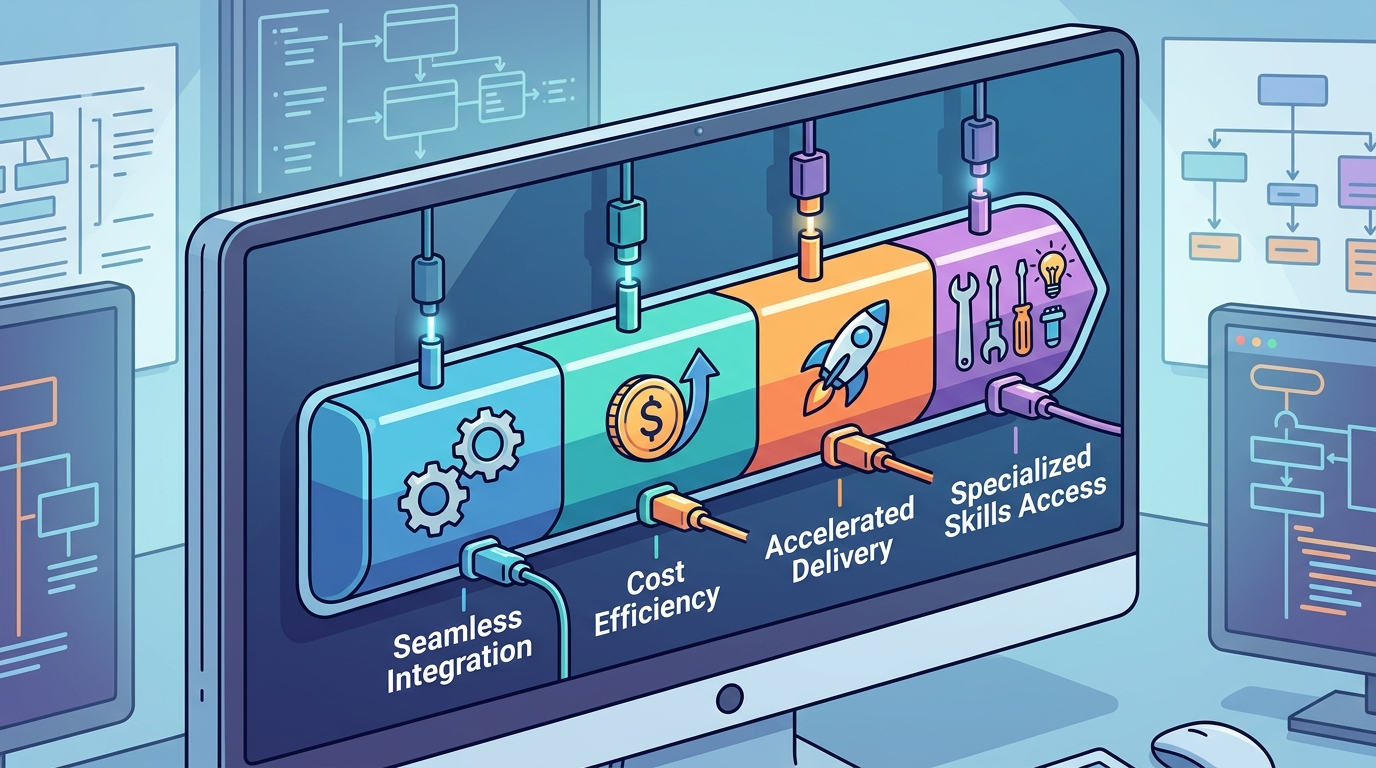
Team augmentation is the practice of integrating external specialists into an in-house team to fill specific skill gaps or accelerate delivery. This approach allows organizations to maintain full project control while accessing immediate expertise. This guide covers the core benefits of team augmentation, including cost efficiency, faster delivery, scalability, and specialized skills access. It also explores how this model supports project control, knowledge transfer, and flexible capacity scaling for modern software development. For additional details, review the Explore Our Services.
Cost Efficiency
Cost efficiency is a primary driver for organizations adopting team augmentation. Hiring full-time employees involves significant overhead, including recruitment costs, benefits, and long-term salary commitments. Augmentation allows companies to pay only for the specific expertise needed during a project phase. This model reduces the financial risk associated with long-term staffing.
Reducing Overhead Costs
Traditional hiring requires a lengthy recruitment process that can take months. Team augmentation provides immediate access to vetted professionals. This eliminates the need for extensive onboarding and training for short-term needs. Organizations can allocate their budget directly to project execution rather than administrative overhead.
Optimizing Resource Allocation
By using augmented teams, companies can match their spending to their actual workload. This prevents the financial drain of idle staff during slower periods. It also avoids the rush and expense of emergency hiring during peak demand. This flexibility ensures that every dollar spent contributes directly to project progress.
Faster Delivery
Faster delivery is a critical advantage of team augmentation in the tech industry. Time-to-market is a key competitive factor for software products. Augmented teams bring immediate experience and established workflows to the table. This accelerates the development lifecycle from concept to launch.
Immediate Productivity
External specialists often arrive with pre-existing knowledge of specific technologies. This reduces the learning curve and allows them to contribute effectively from day one. In-house teams can focus on core business logic while augmented members handle specialized tasks. This parallel work structure significantly speeds up project milestones.
Streamlined Processes
Scalability
Scalability is the ability to adjust team size and capabilities in response to project demands. Team augmentation provides a highly scalable solution for tech projects. It allows organizations to expand or contract their workforce without the complexities of traditional hiring or layoffs.
Dynamic Team Composition
Projects often have fluctuating resource requirements. Augmentation allows teams to scale up during critical phases and scale down when the workload decreases. This dynamic composition ensures that the team remains lean and efficient. It also provides the necessary bandwidth to handle unexpected challenges or scope changes.
Global Talent Access
Augmentation provides access to a global pool of talent. This expands the available skill set beyond local market limitations. Organizations can find the right expertise regardless of geographic location. This global reach enhances the scalability of the project by providing diverse perspectives and solutions.
Specialized Skills Access
Specialized skills access is a defining benefit of team augmentation. Tech projects often require niche expertise that is not available within the in-house team. Augmentation provides immediate access to these specialized skills. This ensures that complex technical challenges are addressed by qualified professionals.
Niche Technology Expertise
Modern software development involves a wide range of technologies. From AI integration to AR/VR experiences, specialized knowledge is often required. Augmented teams bring deep expertise in these specific areas. This allows projects to leverage cutting-edge technologies without the need for extensive internal training.
Industry-Specific Knowledge
Some projects require knowledge of specific industry regulations or standards. Augmented professionals often have experience in these verticals. This industry-specific knowledge helps navigate compliance and best practices. It reduces the risk of errors and ensures that the final product meets industry expectations.
Project Control
Project control is a key advantage of team augmentation over outsourcing. In an augmentation model, external specialists work directly under the management of the in-house team. This ensures that the organization retains full authority over project decisions and direction.
Direct Management
Augmented team members are integrated into the existing team structure. They report to in-house managers and follow established company protocols. This direct management ensures alignment with business goals and quality standards. It also facilitates clear communication and accountability.
Quality Assurance
Maintaining quality is easier when the in-house team has direct oversight. Augmented members are subject to the same code reviews and testing processes as internal staff. This ensures consistency and high standards across the project. It also allows for immediate feedback and course correction when issues arise.
Knowledge Transfer
Knowledge transfer is a significant benefit of team augmentation. Working alongside external specialists provides an opportunity for in-house teams to learn new skills and techniques. This continuous learning environment enhances the long-term capabilities of the organization.
Mentorship and Training
Augmented professionals often serve as mentors to in-house team members. They share their expertise and best practices through daily collaboration. This informal training helps internal staff develop new competencies. It also fosters a culture of continuous improvement and innovation.
Documentation and Best Practices
Augmented teams often bring their own documentation and process frameworks. These resources can be adopted by the in-house team to improve their own workflows. This transfer of knowledge helps standardize practices and improve efficiency. It also creates a repository of institutional knowledge that benefits future projects.
Flexible Capacity Scaling
Flexible capacity scaling is the ability to adjust team resources in real-time. Team augmentation provides a highly flexible approach to capacity management. It allows organizations to respond quickly to changing project requirements.
Short-Term vs Long-Term Needs
Projects often have both short-term and long-term resource needs. Augmentation allows teams to address immediate gaps while planning for future requirements. This flexibility ensures that the team remains balanced and effective. It also provides the option to convert augmented members to full-time employees if the need becomes permanent.
Risk Mitigation
Flexible capacity scaling helps mitigate project risks. By having the ability to quickly add or remove resources, teams can better manage scope and timeline changes. This agility reduces the likelihood of project delays or budget overruns. It also provides a safety net for unexpected technical challenges.
Faster Project Delivery
Faster project delivery is the culmination of the benefits discussed in this guide. Team augmentation accelerates every phase of the development lifecycle. From planning to deployment, augmented teams contribute to a more efficient process.
Parallel Workflows
Augmented teams enable parallel workflows that speed up development. Multiple specialists can work on different components of the project simultaneously. This parallelism reduces the overall project timeline. It also allows for more frequent iterations and feedback cycles.
Reduced Bottlenecks
By adding specialized expertise, augmented teams reduce bottlenecks in the development process. Complex tasks are handled by qualified professionals, preventing delays. This smooth workflow ensures that the project stays on track. It also allows the in-house team to focus on strategic priorities.
Comparison of Team Augmentation Models
| Model | Control | Cost Structure | Scalability | Knowledge Transfer |
|---|---|---|---|---|
| In-House Hiring | High | High Fixed Cost | Low | High |
| Team Augmentation | High | Variable Cost | High | Medium |
| Full Outsourcing | Low | Variable Cost | High | Low |
Key Takeaways
- Team augmentation provides cost efficiency by reducing overhead and optimizing resource allocation.
- Faster delivery is achieved through immediate productivity and streamlined processes.
- Scalability allows organizations to adjust team size and capabilities in response to project demands.
- Specialized skills access ensures that complex technical challenges are addressed by qualified professionals.
- Project control is maintained through direct management and quality assurance.
- Knowledge transfer enhances the long-term capabilities of the in-house team.
- Flexible capacity scaling helps mitigate project risks and manage changing requirements.
- Faster project delivery is the result of parallel workflows and reduced bottlenecks.
Frequently Asked Questions
What is team augmentation?
Team augmentation is the practice of integrating external specialists into an in-house team to fill specific skill gaps or accelerate delivery.
How does team augmentation differ from outsourcing?
Team augmentation involves working directly with the in-house team under their management, while outsourcing involves handing over the entire project to an external vendor.
Is team augmentation cost-effective?
Yes, team augmentation is often more cost-effective than hiring full-time employees for short-term or specialized needs.
Can augmented teams work remotely?
Yes, augmented teams can work remotely, providing access to a global pool of talent.
How does team augmentation improve project control?
Team augmentation allows the in-house team to maintain direct management and oversight of external specialists.
What types of skills can be augmented?
Any specialized skill, including AI, AR/VR, mobile development, and other niche technologies, can be augmented.
How long does it take to integrate an augmented team?
Integration can happen quickly, often within days, depending on the complexity of the project and the expertise of the augmented members.
Does team augmentation support knowledge transfer?
Yes, working alongside external specialists provides an opportunity for in-house teams to learn new skills and techniques.
Conclusion
Team augmentation offers a powerful solution for modern tech projects. It provides the benefits of cost efficiency, faster delivery, and scalability while maintaining full project control. By accessing specialized skills and facilitating knowledge transfer, organizations can enhance their long-term capabilities. For companies looking to accelerate their digital product development, team augmentation is a strategic advantage. Contact MEDL Mobile to learn how our team augmentation services can support your next project.