

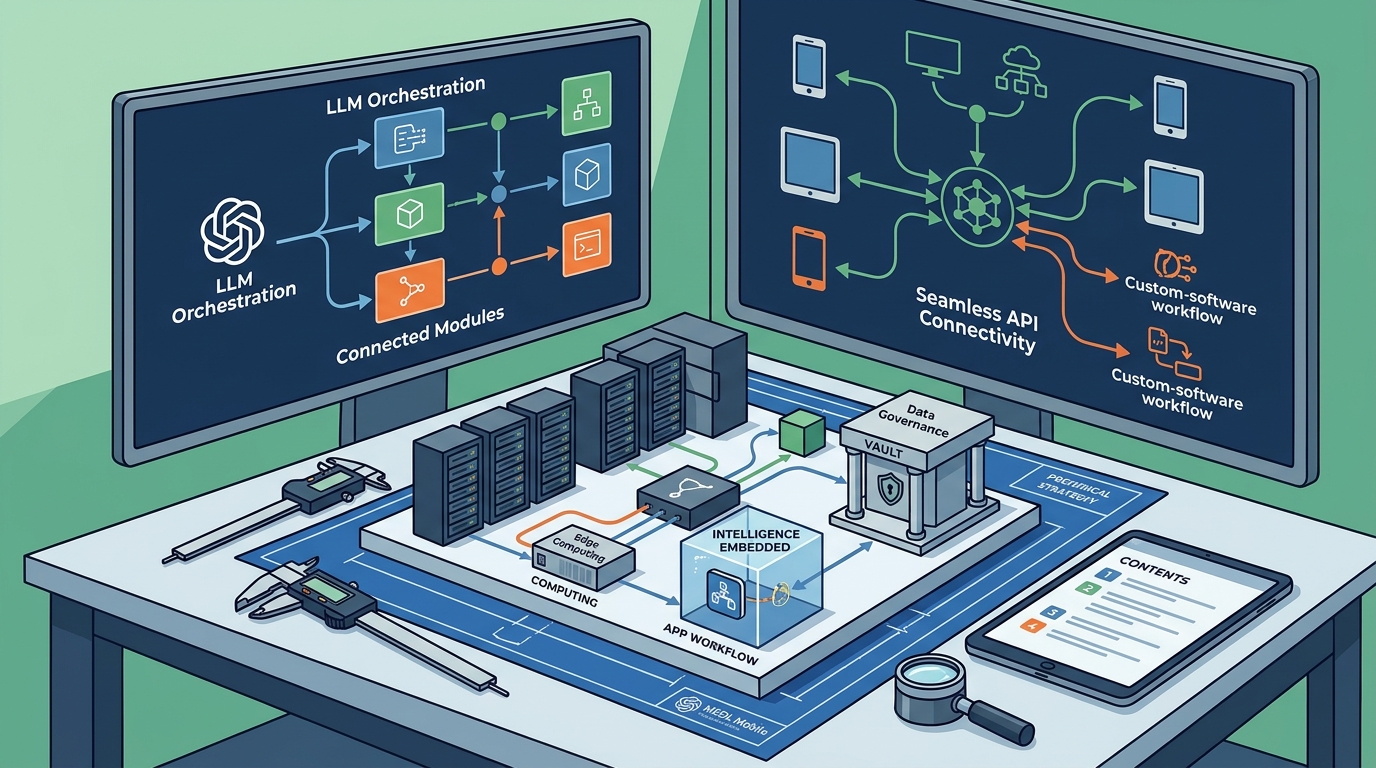
When selecting a software development partner, you must verify their practical AI integration experience through specific technical deliverables and architectural strategies. Look for partners who demonstrate proficiency in Large Language Model (LLM) orchestration, robust data governance, and seamless API connectivity. MEDL Mobile emphasizes that true AI expertise goes beyond simple API calls, requiring a deep understanding of how to embed intelligence into user workflows without compromising performance or security.
Architectural Strategy and System Design
AI integration is not merely a feature add-on; it is a fundamental architectural decision that dictates system scalability and latency. A competent partner must demonstrate the ability to design systems that handle the unique computational demands of AI models. This involves understanding where to place inference logic, whether on the edge, in the cloud, or on-device, to balance cost with user experience. For additional details, review the Explore Our Services MEDL.
Strong partners provide clear documentation on their architectural choices. They explain how they manage state in conversational AI and how they handle the non-deterministic nature of generative outputs. For instance, a partner building a customer support bot must detail how they structure the context window to maintain conversation coherence over time. This level of technical transparency indicates a team that has solved these problems in production environments, not just in proof-of-concepts. For additional details, review the MEDL Mobile AI App.
Data Governance and Security Protocols
AI systems are only as good and safe as the data they process. Data governance is the framework of policies and procedures that ensures data quality, security, and compliance throughout its lifecycle. When evaluating a partner, you must ask how they handle sensitive user data in the context of AI training and inference. Do they use private endpoints? Do they implement strict access controls for model parameters?
Security is paramount when integrating AI into enterprise applications. A reliable partner will outline their approach to prompt injection attacks, data leakage prevention, and model poisoning. They should demonstrate experience with encryption at rest and in transit, specifically tailored for AI workloads. For example, a healthcare application partner must show how they ensure that patient data used for diagnostic AI does not leak into public model weights or logs.
Implications for your organization include regulatory compliance and brand trust. If your partner lacks robust data governance, you risk violating regulations like GDPR or HIPAA. Furthermore, a data breach involving AI models can have severe reputational consequences. Ensure your partner has a dedicated security team that understands the specific threats posed by AI systems.
Model Selection and Orchestration Capabilities
Model selection is the process of choosing the right AI model for a specific task based on accuracy, cost, and latency requirements. A skilled partner does not default to the largest or most famous model for every use case. Instead, they evaluate a range of options, including open-source models, proprietary APIs, and fine-tuned variants, to find the optimal balance for your specific needs.
Orchestration refers to the coordination of multiple AI models and tools to complete complex tasks. This is a critical differentiator. Simple AI integrations might use a single model for text generation. Advanced integrations use orchestration frameworks to route queries to specialized models, retrieve relevant data from vector databases, and execute code. A partner with strong orchestration experience can build agentic systems that perform multi-step tasks autonomously.
The implication is operational efficiency and cost control. By selecting the right model for each sub-task, a partner can significantly reduce API costs while maintaining high accuracy. For example, using a smaller, faster model for initial classification and a larger, more capable model for complex reasoning can optimize performance. Look for partners who can demonstrate this nuanced approach to model management.
Performance Optimization and Latency Management
Performance optimization is the practice of improving the speed and efficiency of AI applications to ensure a responsive user experience. In AI development, latency is a critical metric. Users expect near-instant responses, but generating text or images can take seconds. A competent partner must demonstrate techniques to mitigate this, such as streaming responses, caching, and asynchronous processing.
Specific technical indicators include how the partner handles token generation speed and how they manage concurrent user requests. They should be able to discuss their experience with load testing AI endpoints and scaling infrastructure to handle traffic spikes. For instance, a partner building a real-time translation app must show how they minimize the delay between input and output to maintain conversational flow.
The implication for your product is user retention and satisfaction. High latency leads to user frustration and abandonment. A partner who prioritizes performance optimization ensures that your AI features feel seamless and intuitive. They should provide benchmarks and performance metrics from previous projects to prove their capability in this area.
Key Takeaways
- Verify architectural strategy by asking how the partner designs for scalability and latency in AI systems.
- Assess data governance protocols to ensure compliance with security and privacy regulations.
- Evaluate model selection skills to confirm the partner chooses cost-effective and accurate models for specific tasks.
- Review orchestration capabilities to see if they can build complex, multi-step agentic workflows.
- Check performance optimization techniques, such as streaming and caching, to ensure a responsive user experience.
- Request case studies that demonstrate production-level AI deployments, not just prototypes.
Frequently Asked Questions
What is the difference between AI integration and AI development?
AI integration involves embedding existing AI models or APIs into a software product to enhance its functionality. AI development refers to the creation of new AI models or the fine-tuning of existing ones. Most software partners focus on integration, leveraging pre-trained models to solve specific business problems.
How do I verify a partner's AI experience?
Request detailed case studies that include technical architecture diagrams and performance metrics. Ask for references from clients who have deployed AI features in production. Conduct a technical interview with their lead engineers to assess their depth of knowledge in LLM orchestration and data security.
Why is latency important in AI applications?
Latency is the delay between a user's input and the AI's response. High latency degrades the user experience, causing frustration and abandonment. Optimizing latency through techniques like streaming and caching is essential for maintaining user engagement and satisfaction.
What role does data governance play in AI integration?
Data governance ensures that data used for AI training and inference is secure, compliant, and high-quality. It involves implementing policies for data access, encryption, and retention. Strong data governance prevents data breaches and ensures regulatory compliance.
Can a partner integrate multiple AI models into one application?
Yes, through model orchestration, a partner can integrate multiple AI models to handle different tasks. For example, one model might handle text summarization while another handles image recognition. This approach allows for more complex and capable AI applications.
How does MEDL Mobile approach AI integration?
MEDL Mobile approaches AI integration by focusing on strategic planning and robust engineering. They collaborate with clients to define clear use cases and select the appropriate models. Their team ensures that AI features are seamlessly integrated into the user experience while maintaining high performance and security standards.
Conclusion
Selecting the right software development partner for AI integration requires a deep dive into their technical capabilities and strategic approach. Focus on their experience with architectural design, data governance, model orchestration, and performance optimization. MEDL Mobile offers the expertise and track record to help you navigate these complexities. To discuss your AI integration needs, for a strategic consultation. Learn more: Explore Our Services MEDL.